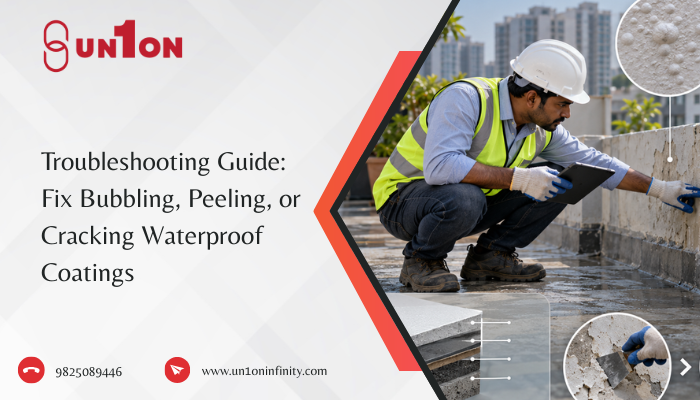
Waterproof coatings are meant to shield your walls, roof, and industrial floors from any water damages. It is therefore disappointing to see your waterproofing coating bubble, flake, or crack.
This is a common headache across Indian homes and businesses, especially once the monsoon sets in and moisture finds every weak spot.
The good news is that most of these failures have clear causes, and once you spot the real problem, fixing it becomes a lot simpler.
This guide covers how to fix bubbling, peeling, and cracking waterproof coating issues, whether you’re a homeowner, a contractor, or handling maintenance for an industrial site.
Why Do Waterproof Coatings Fail?
Before jumping into repairs, it helps to know why the failure happened. Recoating over a hidden problem usually brings it right back.
Common causes include:
- Trapped moisture
- Dust or oil residue
- Weak bonding
- Wet surface application
- Wrong mixing ratio
- Structural movement
- Extreme heat or rain
A flat in Mumbai might bubble because of seepage and humidity. A rooftop in Ahmedabad might crack from constant heating and cooling. It is important to remember that the correct solution depends upon the real cause.
How to Fix Bubbling, Peeling, or Cracking Waterproof Coatings
1. How to Fix Bubbling Waterproof Coatings
These bubbles will take the form of raised spots or blisters in the film. Some will remain small while others will grow in size until they rupture.
Causes of Bubbles:
- Moisture trapping
- Wet substrates
- Exposure to sunlight
- Bad adhesion
- Air trapping
Step-by-step repair:
Step 1: Checking the bubbles
Whether the bubbles are soft, hard, dry or wet should be checked. Leakage or cracking around the bubbles must be checked.
Step 2: Removing the loose coating
The loose coating must be removed completely. No loose coating should remain.
Step 3: Identify the moisture source
There might be leakage or moisture coming from the plumbing. The issue should be sorted out first.
Step 4: Proper drying time
Time should be provided adequately depending upon the climatic conditions and substrate condition.
Step 5: Reapplication of coating
Apply primer followed by the appropriate wall waterproof coating in layers.
Practical Tip: In case bubbles continue to form, the true problem is the continued moisture pressure rather than just an error made once.
2. How to Fix Peeling Waterproof Coatings
Peeling takes place when the paint does not stick to the surface; hence, it is easily removed from it.
Reasons for peeling:
- Dust particles on the surface
- Low-quality plaster
- Old or inappropriate paint
- Water issues
- Inappropriate priming
Step-by-step repair:
- Removal of all loose materials
Scrape until you get a good and well-bonded substrate.
- Substrate repair
Close all cracks and repair any weak plaster or concrete substrates.
- Surface cleaning
Remove any dust, greases, or salts on the surface.
- Apply correct primer
Use the right primer according to your substrate.
- Apply fresh coating
Follow the recommended number of coats and drying time.
A wall waterproof coating made for a dry interior won’t survive a permanently damp bathroom or basement. Match the product to the actual exposure.
3. How to Fix Cracking Waterproof Coatings
Cracks are more difficult than bubbles because they may be indicating some more substantial movement behind them.
Types of cracks:
- Hairline cracks
- Structural cracks
Steps for repairing cracks:
Step 1: Inspection of the crack
Measure the crack in terms of width and depth, and see whether the crack is expanding.
Step 2: Finding the cause
Shrinkage, expansion due to heat, movement, or bad preparation.
Step 3: Repair by crack type
Use crack filler for small, stable cracks.
Step 4: Surface Preparation
Clean the area surrounding the crack and remove the existing coating.
Step 5: Apply the waterproofing system
Use a flexible coating with reinforcement where needed.
Important: Cracks near beams, columns, or slabs aren’t cosmetic. Get those checked by a qualified engineer before recoating.
How to Choose the Right Waterproof Coating Manufacturer
Many of these failures trace back to one thing: the product wasn’t right for the job.
Before buying from any waterproof coating manufacturer, check:
- Surface compatibility
- Water exposure level
- Crack-bridging ability
- Primer requirement
- Technical documentation
- Weather durability
- Support after sale
For industrial projects, also factor in chemical exposure, temperature swings, and cleaning routines. A cheap product that fails in two years always costs more than a reliable one that lasts ten.
Wall Waterproof Coating vs Industrial Waterproof Coating
| Feature | Wall Waterproof Coating | Industrial Waterproof Coating |
| Typical use | Homes, bathrooms, exteriors | Factories, warehouses |
| Main concern | Dampness and seepage | Chemicals, wear, water |
| Surface | Plaster, masonry, concrete | Concrete, metal |
| Selection factor | Weather resistance | Chemical resistance, durability |
| Application | Usually simpler | Needs specialised prep |
Both need proper preparation and correct application. The real difference is how much daily stress the surface has to handle.
Common Mistakes to Avoid
Coating Over Peeling Paint
New material can’t bond to a weak layer underneath.
Better approach: Remove loose coating first.
Ignoring Dampness
Painting over a wet wall traps moisture inside.
Better approach: Fix the damp source first.
Using the Wrong Product
Interior-grade coatings can’t handle industrial exposure.
Better approach: Match product to conditions.
Applying Too Much Material
Thicker isn’t always better here.
Better approach: Stick to recommended thickness.
Skipping the Inspection
Just repairing the visible damage solves nothing.
Better approach: Conduct inspection before repair.
Frequently Asked Questions
1. Can the bubbling waterproof coating be repaired without removing it?
Not completely. The bubbling portion should be removed, and the water source should be solved before the reapplication of the coating.
2. What makes my wall waterproofing coating peel after the rain?
The main causes include poor adhesion, moisture, or poor quality of the plasterwork.
3. Can waterproofing coating prevent the cracks from spreading?
Flexibility of the coating can help fill small cracks, but first you need to evaluate the structural movement.
4. How often must waterproof coatings be tested in India?
Twice a year, before and after monsoons, and more frequently in industries.
5. How do I choose an industrial waterproof coating manufacturer?
Look for exposure-specific products, clear technical documentation, and a team that actually supports application, not just the sale.
Conclusion
Bubbling, peeling, and cracking are your coating’s way of signalling something needs fixing, not just hiding. Identify the cause, prepare the surface right, and choose a compatible system.
Whether you need a wall waterproof coating for your home or an industrial waterproof coating for your factory, product selection and application quality decide how long it actually lasts.
Looking for a reliable waterproof coating manufacturer? Check out Un1onInfinity.