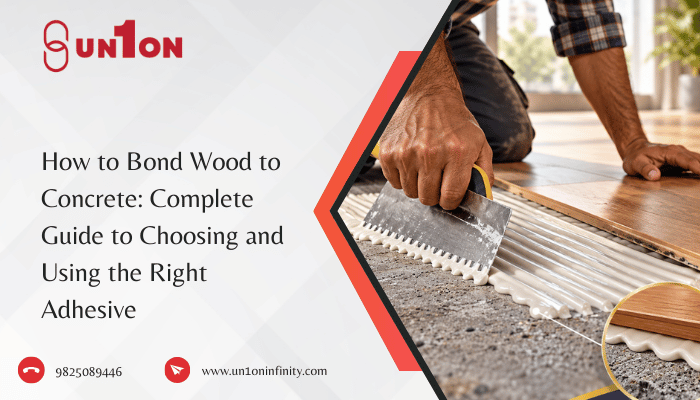
Bonding wood to concrete is common in flooring, construction, furniture installation, renovation, plywood subfloors, and interior projects. Unlike wood-to-wood bonding, this application involves two very different surfaces. Wood is porous and can absorb moisture, while concrete is hard, mineral-based, and may contain dust or residual moisture.
Choosing the correct adhesive and preparing both surfaces properly are essential for achieving a strong and durable bond. The right product can reduce the need for mechanical fasteners while providing reliable adhesion across the joint.
This complete guide explains how to select the right adhesive, prepare wood and concrete surfaces, apply the adhesive correctly, understand curing requirements, and avoid common bonding problems.
Can You Bond Wood to Concrete With Adhesive?
Yes, wood can be bonded to concrete using a suitable construction or structural adhesive. However, the adhesive must be compatible with both materials and the conditions of the installation.
A bonding application inside a dry room may have different requirements from a plywood subfloor exposed to moisture, temperature changes, or regular foot traffic.
| Factor | Why It Matters |
| Concrete condition | Dust or loose material can weaken adhesion |
| Wood type | Porosity affects adhesive absorption |
| Moisture | Excess moisture can cause bond failure |
| Load | Heavy or structural applications require stronger bonding |
| Temperature | Some adhesives have specific temperature limits |
| Movement | Wood can expand and contract with humidity |
| Application area | Large areas may require longer working time |
Always check the adhesive manufacturer’s technical specifications before starting a permanent installation.
What Is the Best Adhesive for Wood-to-Concrete Bonding?
There is no single adhesive that is best for every wood-to-concrete application. The appropriate product depends on the materials, load, moisture conditions, flexibility requirements, and intended use.
An adhesive for concrete and wood should generally provide strong adhesion to porous concrete as well as wood while maintaining sufficient flexibility to accommodate minor movement.
Common adhesive categories include:
| Adhesive Type | Key Benefit | Suitable Applications |
| Construction adhesive | Strong general-purpose bonding | Interior construction |
| Polyurethane adhesive | Good adhesion and flexibility | Wood, flooring and construction |
| Epoxy adhesive | High strength | Heavy-duty applications |
| Hybrid polymer adhesive | Flexible and durable | Construction and renovation |
| Flooring adhesive | Designed for flooring systems | Wood and plywood flooring |
For demanding projects, consider the expected load, moisture exposure, temperature, and movement before choosing the adhesive.
Adhesive for Plywood to Concrete: What Should You Consider?
Plywood is frequently installed over concrete as part of flooring and subfloor systems. Because plywood can absorb moisture and expand or contract, the adhesive must be selected with these characteristics in mind.
When choosing an adhesive for plywood to concrete, consider the following factors.
Moisture Resistance
Concrete can retain moisture even when the surface appears dry. Excess moisture may affect plywood and adhesive performance. Check the concrete moisture condition before installation and follow the adhesive manufacturer’s requirements.
Bond Strength
The adhesive should provide adequate strength for the expected traffic and loads. Flooring applications generally require more reliable performance than temporary or decorative installations.
Flexibility
Wood naturally responds to changes in humidity and temperature. A slightly flexible adhesive can help accommodate minor movement between the two materials.
Open Time
Large plywood sheets may require enough working time to position them correctly. A product that cures too quickly can make installation difficult.
Surface Compatibility
Always confirm that the adhesive is approved for both the plywood type and concrete substrate.
How to Bond Wood to Concrete Step by Step
Following the correct installation process can significantly improve bond performance.
Step 1: Inspect the Concrete
Check the concrete for cracks, loose particles, oil, paint, curing compounds, or other contaminants. The surface should be structurally sound.
Step 2: Clean the Surface
Remove dust and debris using an appropriate cleaning method. A clean surface allows the adhesive to make better contact with the concrete.
Step 3: Prepare the Wood
Make sure the wood or plywood is clean, dry, and free from grease, dust, or loose material. Sanding may be required if the surface is excessively smooth or contaminated.
Step 4: Test the Fit
Position the wood before applying adhesive. Check dimensions, alignment, edges, and joints so adjustments can be made without adhesive on the surface.
Step 5: Apply the Adhesive
Apply the recommended amount using the manufacturer’s specified method. Depending on the product, this may involve beads, lines, a notched trowel, or another application method.
Step 6: Position the Wood
Place the wood onto the concrete carefully. Press or apply suitable pressure according to the adhesive instructions to achieve proper contact.
Step 7: Allow the Adhesive to Cure
Avoid moving or loading the bonded material until the recommended curing time has passed.
Factors That Affect Wood-to-Concrete Bond Strength
The quality of the final bond depends on more than the adhesive itself. Several installation and environmental factors can influence performance.
Surface Cleanliness
Dust, grease, oil, paint, and loose concrete particles can prevent the adhesive from making proper contact with the substrate. Both surfaces should be clean before application.
Concrete Moisture
Concrete can retain moisture even after it appears completely dry. Excess moisture may affect adhesive performance and can also cause wood or plywood to swell.
Wood Moisture Content
Wood naturally contains moisture and can expand or contract as environmental conditions change. Excessively wet wood should not be bonded unless the adhesive system is specifically designed for those conditions.
Temperature
Very high or low temperatures can change the adhesive’s working time and curing performance. Follow the product’s recommended application temperature range.
Adhesive Coverage
Insufficient adhesive coverage can create weak areas, while excessive adhesive may increase curing time and create an uneven installation.
| Bonding Factor | Potential Effect |
| Dust | Reduces surface contact |
| Excess moisture | Can weaken the bond |
| Oil or grease | Prevents proper adhesion |
| Incorrect temperature | Changes curing behaviour |
| Poor adhesive coverage | Creates weak spots |
| Wood movement | Can stress the adhesive joint |
Wood-to-Concrete Adhesive Application Methods
The application method depends on the adhesive type, project size, and manufacturer’s instructions.
Bead Application
The adhesive is applied in continuous or controlled beads across the surface. This method can be useful for construction applications where complete surface spreading is not required.
Trowel Application
A notched trowel can be used for certain flooring adhesives. It helps distribute the adhesive more evenly across a larger area.
Full-Surface Application
Some applications require adhesive to cover most or all of the bonding area. This can provide more consistent contact when specified by the adhesive and flooring manufacturer.
| Application Method | Best Suited For |
| Beads | Construction and smaller bonding areas |
| Notched trowel | Flooring and large surfaces |
| Full coverage | Applications requiring extensive contact |
| Controlled dispensing | Precise professional installations |
Always use the application method specified on the adhesive’s technical data sheet.
Choosing Adhesive for a Plywood Subfloor
A plywood subfloor requires careful adhesive selection because the flooring system may experience continuous foot traffic, vibration, temperature changes, and moisture variations.
When selecting an adhesive for a plywood subfloor, consider these requirements:
| Requirement | What to Check |
| Bond strength | Suitable for continuous floor loads |
| Moisture resistance | Appropriate for the concrete environment |
| Flexibility | Can accommodate minor wood movement |
| Working time | Allows proper plywood positioning |
| Curing time | Suitable for the installation schedule |
| Substrate compatibility | Approved for concrete and plywood |
| Long-term durability | Suitable for permanent installation |
For large flooring projects, always follow the flooring manufacturer’s installation instructions along with the adhesive manufacturer’s technical data.
How to Prepare Wood and Concrete Surfaces Before Bonding
Surface preparation is one of the most important parts of wood-to-concrete bonding. Even a high-performance adhesive can fail if it is applied over dust, oil, moisture, or loose material.
Preparing Concrete
The concrete should be:
- Clean
- Stable
- Free from loose particles
- Free from oil and grease
- Suitable in terms of moisture level
- Free from contaminants that could interfere with adhesion
Remove surface dust thoroughly before adhesive application.
Preparing Wood
The wood should be:
- Clean and dry
- Free from oil and grease
- Free from loose fibres
- Properly sized and positioned
- Compatible with the selected adhesive
If sanding is required, remove all sanding dust before bonding.
The adhesive’s set time, working time, and full cure time are not necessarily the same, so these terms should not be treated as interchangeable.
Wood and Concrete Compatibility Guide
Different wood products can behave differently when bonded to concrete. The surface characteristics of the wood should therefore be considered before selecting an adhesive.
| Wood Material | Key Consideration |
| Plywood | Check moisture resistance and substrate compatibility |
| Hardwood | May have lower surface porosity |
| Softwood | Can absorb adhesive more readily |
| MDF | Highly porous and sensitive to moisture |
| OSB | Surface texture can affect adhesive contact |
| Laminated wood | Check whether the adhesive bonds to the exposed surface |
A small test area can help determine whether the selected adhesive provides the required adhesion before starting a larger installation.
Common Problems When Bonding Wood to Concrete
Several problems can reduce the strength or durability of the bond.
| Problem | Possible Cause | Prevention |
| Adhesive does not stick | Dust or contamination | Clean both surfaces |
| Wood lifts from concrete | Insufficient adhesive contact | Follow application instructions |
| Bond becomes weak | Excess moisture | Check moisture conditions |
| Cracks appear | Excessive movement | Select suitable flexible adhesive |
| Uneven bonding | Incorrect application | Apply adhesive consistently |
| Premature failure | Insufficient curing | Allow full curing time |
| Wood changes shape | Moisture or humidity | Condition and store wood correctly |
One of the most common mistakes is assuming that a dry-looking concrete surface is completely free of moisture. Moisture testing may be necessary for flooring applications.
How to Improve Long-Term Adhesive Performance
Proper installation is only the first step. The bonded assembly should also be protected from conditions that could reduce adhesive performance.
For better long-term results:
- Prevent unnecessary water exposure.
- Follow recommended installation temperatures.
- Avoid excessive mechanical stress during curing.
- Use the correct adhesive thickness.
- Store adhesive according to manufacturer instructions.
- Check the shelf life before application.
- Use compatible primers when specifically recommended.
- Follow the substrate preparation requirements.
For large commercial or flooring installations, documenting the adhesive batch, surface preparation, and installation conditions can also help maintain consistency across the project.
Quick Checklist Before Bonding Wood to Concrete
Use this checklist before starting the installation:
| Checklist Item | Status |
| Concrete is structurally sound | ✓ |
| Concrete surface is clean | ✓ |
| Loose dust and particles removed | ✓ |
| Moisture condition checked | ✓ |
| Wood or plywood is suitable | ✓ |
| Adhesive is compatible with both materials | ✓ |
| Application method confirmed | ✓ |
| Temperature is within recommended range | ✓ |
| Wood is correctly positioned | ✓ |
| Recommended curing time understood | ✓ |
Completing these checks before application can help prevent avoidable bonding problems and improve installation consistency.
FAQs About Wood-to-Concrete Adhesives
Can wood be permanently glued to concrete?
Yes. With a compatible construction, polyurethane, epoxy, or hybrid adhesive, wood can be permanently bonded to concrete when the surfaces are properly prepared.
Can plywood be glued directly to concrete?
Yes, provided the plywood and concrete are suitable for the selected adhesive and the concrete meets the manufacturer’s moisture requirements.
Does concrete need to be completely dry before bonding wood?
The required moisture level depends on the adhesive and application. Always follow the manufacturer’s specified moisture limits rather than relying only on visual inspection.
Can construction adhesive bond wood to concrete?
Many construction adhesives are designed for bonding porous building materials, including wood and concrete. However, product specifications should be checked before use.
How long should wood-to-concrete adhesive cure?
Curing time varies by adhesive formulation, temperature, humidity, substrate condition, and joint thickness. Follow the manufacturer’s recommended curing schedule.
Is surface preparation necessary?
Yes. Removing dust, oil, loose material, and other contaminants is essential for achieving reliable adhesion.
Can adhesive replace screws for every application?
No. Adhesive bonding may be appropriate for many non-structural applications, but structural or safety-critical installations may require mechanical fastening or a professionally designed bonding system.
Conclusion
Bonding wood to concrete can provide a strong and practical alternative to mechanical fastening when the right adhesive and installation method are used. The most important factors are material compatibility, surface preparation, moisture conditions, bond strength, flexibility, and curing time.
For plywood flooring and subfloor applications, additional attention should be given to concrete moisture, expected loads, wood movement, and long-term durability. Always select an adhesive specifically suited to the materials and application, prepare both surfaces properly, and follow the manufacturer’s technical instructions.
A carefully selected adhesive combined with proper preparation and application can help create a durable wood-to-concrete bond for construction, flooring, renovation, and other projects.