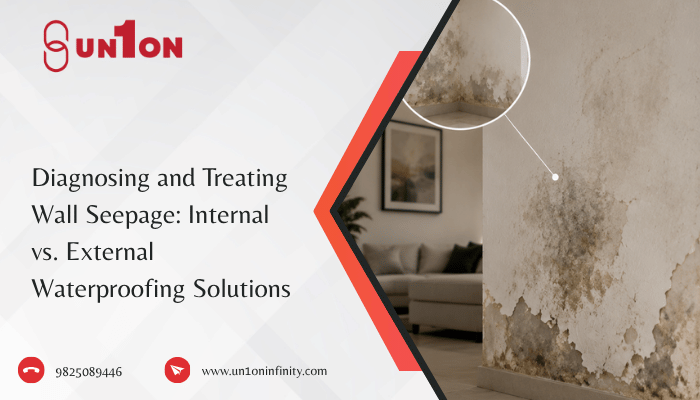
A damp patch on your wall never stays just a patch. Give it a few months, and it turns into peeling paint, a musty smell, and sometimes even a crumbling corner of plaster.
The tricky part about wall seepage treatment is that the visible damage rarely points straight to the cause. A stain in your bedroom could actually be water sneaking in from the terrace two floors up, a cracked balcony ledge, or a pipe joint hidden inside the wall.
This article walks you through how to diagnose wall seepage correctly, explains when internal or external waterproofing makes more sense, and helps you think through what to look for when picking a solution instead of just papering over the problem.
How to Diagnose Wall Seepage
Before you touch a single tin of waterproofing coating, figure out where the water is actually coming from. Skip this step, and you’ll likely be redoing the job in a year.
Watch out for these signs:
- Yellow or brown patches
- Bubbling or peeling paint
- Cracks running through plaster
- White chalky deposits (efflorescence)
- Musty smell in the room
- Damp that worsens in monsoon
- Marks near windows or ceilings
Where the Damp Patch Sits Tells You a Lot
Near the ceiling usually points to a terrace, upstairs bathroom, or an external wall letting water in from above.
Around window frames often means the sealant has worn out, or rain is finding its way through a hairline gap.
Near bathrooms and kitchens, the usual suspects are leaking pipe joints or grouting that’s given up.
At the base of a wall, you’re probably looking at rising dampness or water pooling near the foundation.
If the patch keeps coming back or seems to be spreading, it’s worth getting a professional in with a moisture meter rather than guessing.
Internal vs. External Waterproofing
Whether you go internal or external really comes down to one question: where is the water getting in?
External Waterproofing
This method stops water before it ever touches your wall. It works well when the problem is clearly outside:
- Cracked exterior plaster
- Gaps around pipe openings
- Poorly sealed joints
- Terrace or balcony leakage
- Rain hitting exposed walls directly
Say you’ve got a home in Ahmedabad where a bedroom wall gets damp every single monsoon. Once you check the outside and spot hairline cracks in the plaster, sealing those and applying an external waterproofing coat solves the actual problem instead of repainting the same wall every July.
External work does mean dealing with scaffolding or exterior access, which isn’t always simple in a crowded housing society. But when it’s possible, it tends to give the more lasting fix.
Internal Waterproofing
Sometimes the outside wall just isn’t reachable, like flats in a tall building or a shared wall with a neighbour. That’s where internal treatment steps in.
It works best for:
- Basement walls
- Bathroom and kitchen walls
- Internal cracks
- Plumbing-related dampness
- Spots where external access isn’t possible
One thing worth remembering: internal coatings aren’t a permanent fix for water coming from outside. If rain keeps entering through an external crack, the internal layer will eventually give way too. Diagnosis has to come before you pick a product, not after.
Choosing the Right Waterproofing Products
There’s no single product that solves every seepage issue. What works for a bathroom wall might do nothing for an exposed terrace.
Common options include:
- Cementitious coatings
- Polymer-modified coatings
- Crack fillers
- Joint sealants
- Waterproofing membranes
- Exterior protective coatings
- Injection grouting
When comparing waterproofing product manufacturers, don’t just go with whoever’s cheapest. Check the technical specs, how well the product suits your surface, its durability, and whether the manufacturer actually offers support if something goes wrong.
A terrace coating needs UV resistance and flexibility to handle heat expansion. A bathroom product needs to hold up against constant moisture. Mixing these up is a common (and expensive) mistake.
Practical Wall Seepage Treatment Steps
Here’s a sensible order to follow:
- Inspect the damp area and note when it worsens
- Trace the source — plumbing, cracks, terrace, drainage
- Fix the root cause first
- Prep the surface — remove loose paint and dust
- Apply the right waterproofing system
- Let it cure fully before moving on
- Restore the finish with fresh plaster and paint
Common Mistakes to Avoid
- Painting over the patch without fixing the source
- Treating only the visible area, ignoring what’s spread behind the plaster
- Ignoring small cracks, assuming they’re harmless
- Picking the wrong product for the surface
- Skipping surface prep before applying any coating
FAQs About Wall Seepage Treatment
1. What is the best wall seepage treatment?
It depends entirely on the source. External leaks need external correction; plumbing or wet-area issues need targeted internal repair and waterproofing.
2. How can I identify wall seepage problems at home?
See where the patch is located and when it gets worse, along with any cracks, plumbing leakages or joint damage around it. If the problem continues, contact a specialist.
3. Which is better, interior waterproofing or exterior waterproofing?
One will not beat the other. Exterior waterproofing is good for water entering from the exterior of the building; interior is preferable when exterior access is not available.
4. How can I choose between manufacturers of waterproofing products?
Consider factors such as suitability, technical specifications, ease of application, longevity and after-sales service, not just the cost of the products.
5. Is it possible to stop seepage of walls permanently?
Yes, mostly, but only if the cause has been correctly diagnosed, the surface appropriately prepared, and the correct system selected and maintained.
Conclusion
Good wall seepage treatment isn’t about grabbing the first waterproofing tin you find; it’s about tracking down where the water is actually coming from and fixing that first.
Whether your situation calls for internal or external waterproofing, get the diagnosis right and the rest becomes far easier to solve.
If you’re tired of the same damp patch returning every monsoon, it’s worth talking to a team that understands both the products and the process. Visit UN1ON Infinity to explore waterproofing solutions built for real Indian construction conditions.